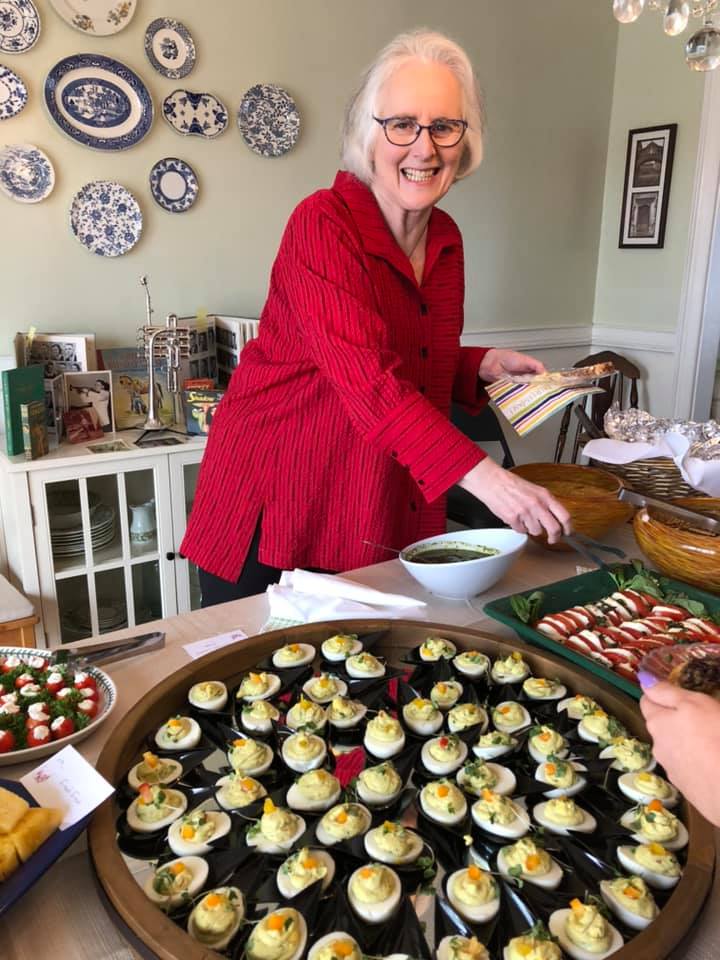
In 1978 when I came to Lacombe to attend Canadian Union College ( now Burman University) I met Bev. We have kept in touch frequently over 40 years.
Bev was my speech teacher – in my work with A Better World, it is one of the most useful subjects and I couldn’t have had a better teacher. Bev was more than just a teacher to many of her students. She was caring, compassionate and always willing to help you. Anticipating what one might be facing she offers to help and be there for you. In August of 2020 she was asked to speak for the convocation at Andrews University in Michigan where she teaches. Here is her inspiring speech
Be Ye Kind Faculty Institute Andrews University HPAC 13 August 2020
On the first day of spring term last school year, I was chatting with a new student, someone I had just met. In the course of our conversation, he asked me something that I wasn’t expecting: “What’s your favorite Bible verse?” I was just about to rattle off a passage that I had claimed since grade school, when I paused. I thought to myself, “My thinking has changed over the years–obviously. I no longer buy anything just because it comes in purple. I now say “no thank you” to strawberries—ever since they started giving me hives. I no longer believe, as I did when I was sixteen, that Rod McKuen is America’s greatest poet. Clearly, my thinking has shifted in ways great and small. I may well be overdue for an upgrade in the favorite Bible verse department.”
After a bit of stammering, I finally responded to my student, “You know, I haven’t said this to anyone before, not even myself, but as of right now, I think my favorite Bible verse is ‘Be ye kind one to another.’ I can’t even tell you where it is in the New Testament, but I know it’s in there somewhere. I need to go find it.”
And I did, soon as our first class together was over. It’s in Ephesians 4, a chapter brimming with advice, including the importance of being humble, gentle, and patient. But the last verse of chapter 4 implores readers to “Be ye kind.”
Now the speech and writing teacher in me knows that what is said or written first and last is typically what is remembered best. It makes sense, then, to pay attention to these places when crafting or receiving any message.
Clearly, being kind mattered to Ephesians’ author and to New Testament editors–perhaps even more than humility, gentleness, and patience. “Be ye kind” earned that place of honor at the end of a chapter.
I’m told there are more than 31,000 verses in scripture’s King James Version. That’s a lot of options when casting about for a favorite verse.
Part of the reason why an English professor might chose this verse, is the appeal of its surprising rhyme, not at the end of the line, but at the beginning: “be ye.” That little rhyme, to my ear, elevates this one simple prose sentence to the ranks of poetry. “Be ye kind one to another.” I’m also drawn to the fluidity of eight vowel sounds spilling out of six simple words; it doesn’t take a phonologist to point out that what we have here is a sentence that can’t help but sing! Also, this verse rises to the top for me because, like Professor George Saunders, I’ve lived long enough to realize that, in the long run, being kind may well matter more than just about anything else.
Saunders is a pretty remarkable chap. He has a degree in geophysical engineering from Colorado School of Mines, and he worked in that field for a good while before going back to school to earn a graduate degree—this time an MA in creative writing. Talk about interdisciplinary! He’s now a professor of creative writing and journalism at Syracuse University, and the recipient of one of literature’s most prestigious awards, the Booker Prize, as well a MacArthur “Genius Grant.” Here’s a colorful snippet, some midlife reflections, that he shared with the graduating class during a convocation at his university:
What do I regret? Being poor from time to time? Not really. Working terrible jobs, like ‘knuckle-puller in a slaughterhouse’? (And don’t even ask what that entails.) No, I don’t regret that. Skinny dipping in a river in Sumatra . . . and looking up and seeing like three hundred monkeys sitting on a pipeline, pooping down into the river, the river in which I was swimming, with my mouth open, naked? And getting deathly ill afterward, and staying sick for the next seven months? Honestly, no. Do I regret the occasional humiliation? Like once, playing hockey in front of a big crowd, including this girl I really liked [and somehow managing] while falling and emitting this weird whooping noise, to score on my own goalie, while also sending my stick flying into the crowd, nearly hitting that girl? No. I don’t regret even that. But here’s something I do regret . . . .”
Saunders goes on to share a memory from junior high. There was this new girl in class who was not on the receiving end of many kind looks, words, or deeds. She chewed a strand of her hair nervously. She was quiet, and kept to herself. More than forty years later, it still bothers Saunders that he wasn’t kinder to this new kid. He wasn’t mean to her exactly, just not kind. She and her family moved away after that seventh-grade school year, and he never saw her again.
This lost opportunity led Saunders to ponder kindness and to make it the theme of his graduation talk–a talk that quickly went viral and was subsequently published as Congratulations, by the way: some thoughts on kindness.
Now, you’re probably thinking, “Good for Saunders. And those young graduates. But I am already kind. I say ‘please’ and ‘thank you.’ I hold doors open for people—even those annoying, swinging, saloon doors at the side entrances to Nethery Hall. I give compliments. And mostly I mean them. I laugh at others’ jokes—even when they’re not all that funny. I’ve memorized the Golden Rule and practice it—most days.” Certainly these are all good things to do. But I think, if we’re honest, we’d agree that many of these actions fall under the category of relatively easy, common civility. What about potential kindnesses that go against our temperaments and natural inclinations, actions that fall outside of our comfort zones, responses that our parents or grandparents would label “going the extra mile”?
As I was rereading Saunders recently and pondering my new favorite Bible verse, three encounters came to mind. Each, in its own way, serves as a kindness epiphany for me. Maybe one of these stories might somehow help you and those you encounter in the terms ahead.
Kindness Narrative #1
Years ago, not long after leaving Andrews with two diplomas, a BA and MA, I was in Vancouver visiting relatives.
Aunt Ruby and I were about to leave her apartment to go sight-seeing. Suddenly, she stopped and said, “Oh wait. I forgot something.” She turned around and reached into a jar sitting on a small table by the door. The jar was full of quarters. She scooped up a handful and put some coins in each pocket.
“For the parking meters?” I asked.
“No,” she answered matter-of-factly. “In case someone asks for money while we’re out.”
“Don’t you feel kind of funny or uncomfortable giving money to someone who is begging?” I asked her. “How do you know what they’re going to do with the money? What if it’s a scam? How do you even know if they really need it?”
“I don’t know,” she said. “I can’t know. But it’s not my job to judge. It’s my job to help—if I possibly can. And most of the time I can—at least a little bit.”
I can’t tell you what we saw in Vancouver that day. But I’ve never forgotten that small conversation and Ruby’s practice of kindness.
Kindness Narrative #2
It was on this campus, in a session similar to those we will be attending today and tomorrow. The speaker was the head Dean of Men—Don Murray. Some of you know him. Don was talking to us about guarding against burnout, and his experience of waking up each day, knowing he faced an impossible task. He explained, “I have about 500 young men under my charge. I can’t possibly interact with all of them every day.
I can’t see or speak to or even nod hello to each one in a day. It can’t be done. But each morning before I start work, I pray, ‘God, make my path intersect with those who need me most this day. Amen.’”
What a great prayer! It’s one I’ve never forgotten. We don’t have to be a dean to pray it. Anyone in the field of education can certainly relate. “May my path intersect with those who need me most this day.” I try to remember to pray that prayer each morning. And since reading Saunders, I add this postscript: “And if I can’t actually be as helpful as I might wish, may I at least be kind.”
Kindness Narrative #3
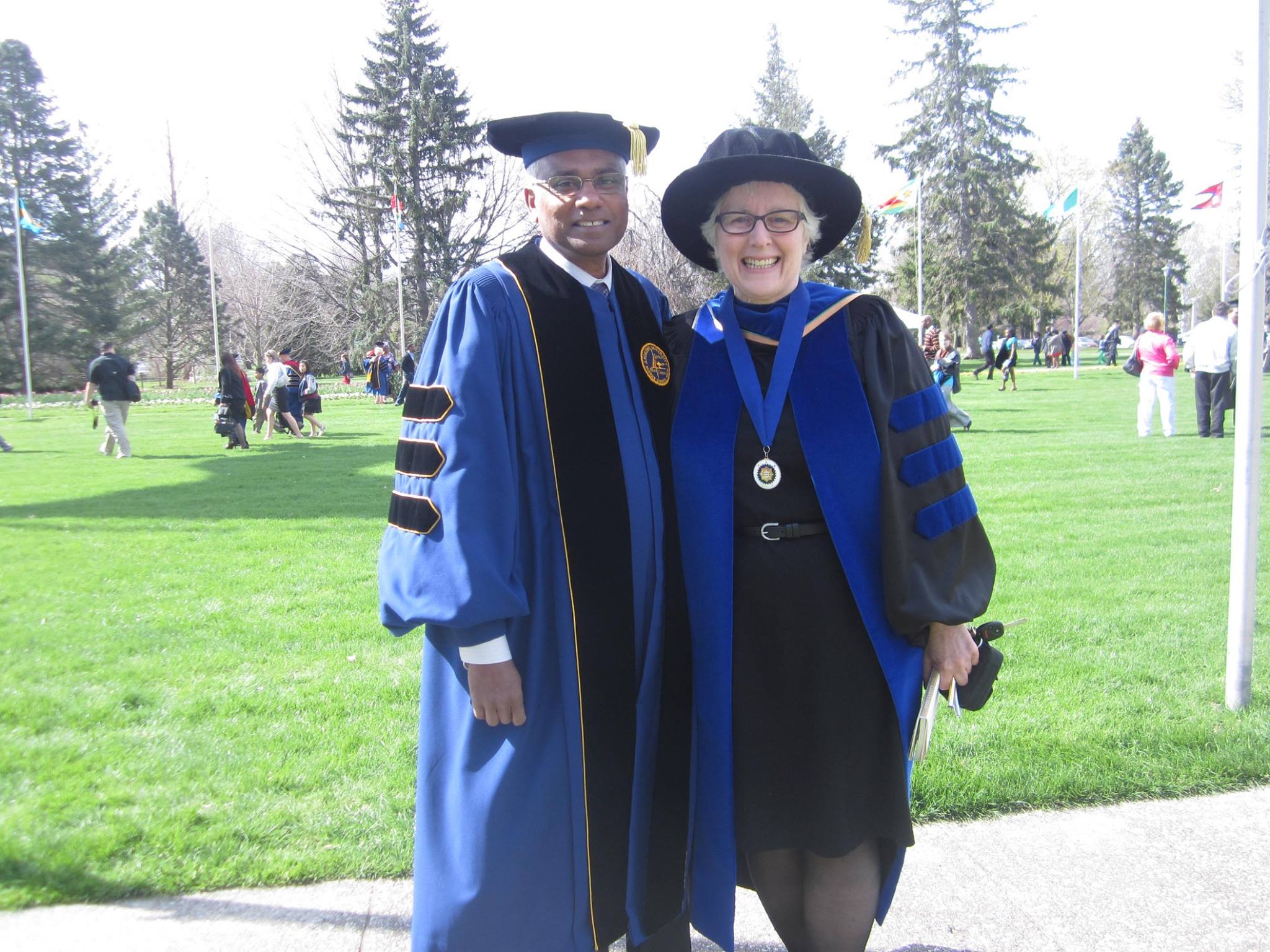
The friend who has probably taught me the most about kindness is Eric. He was a student of mine in my earliest years of teaching in Alberta. I was 23 when we met. Eric was 20. We have stayed in touch over the decades and have visited often. I’m in awe of all that Eric has accomplished—so much, by way of international humanitarian relief and education, that this university granted Eric an well-deserved honorary doctorate a few years go. Eric and his family are immigrants. They arrived in British Columbia when Eric was about 13. I thought I had heard most of Eric’s stories by now, but recently I came across one that was new to me, part of a New Year’s reflection Eric published. In it, he recalls,
Every knock on the door was a rejection. My father had been in Canada for three years before his family joined him. He worked hard, saved money, borrowed, so his family could come to Canada.
But soon after my mom, my two brothers, and I arrived [from Sri Lanka], he lost his job. He would get up every day and go knocking on doors. At supper time, he would tell us how many doors he had knocked on and end with this sentence: ‘Every knock on the door was a rejection.’ It weighed on our family like a stone that got heavier every time he spoke that sentence.
Eric continues:
[Years later] when I started [my own business], Advanced Systems, the policy was and still is that anyone who comes looking for a job would always, on the spot, get an interview—whether or not there was an opening. Most of the time I didn’t have a job [opening] and I would tell them that, but I would offer them an interview anyway.
If I wasn’t in the office, the receptionist was to tell them that I would call them back and invite them to meet. They often told me [afterwards] that these interviews gave them the . . . hope to keep knocking on doors. Beyond that, I circulated their resumes to my colleagues and talked about them and tried to connect them with possible opportunities.
Eric’s article ends with this challenge:
This year, find ways to give people hope: talk to those that feel rejected and tired, be polite in your rejection of the telemarketer, reply to email requests (not the mass ones or spam). Be a door of hope and not of rejection.
One of the ways we are lucky in academia is that we experience more than one New Year annually. There’s the January one, of course, but the start of each school year is another— a bonus New Year, if you will. At the start of this New Year, may each of us, like Ruby, respond without judgement to the outstretched hands and the yearning hearts we encounter. Like Don, may we pray each morning, “Help my path to intersect with those who need me most this day.” And like Eric, may we be a door of hope and not rejection. May each of us, in this new school year, find ways to “Be ye kind one to another.”
And one more thing: while we’re graciously accepting proffered kindnesses, let’s not forget to be kind to ourselves as well.
 Eric Rajah